Tesla Supercharger Membership Break-Even: Is It Worth It in 2026?
By Morgan Ellis · Published Oct 14, 2026

Photo: Bahnfrend / Wikimedia Commons, CC BY-SA 4.0. Original photograph, August 2024, Poland; used to illustrate the Supercharger network, not a U.S. pricing or non-Tesla compatibility test. No edits to the source image; the cover may be cropped by the site layout. The photograph and any cover crop retain the CC BY-SA 4.0 license.
Quick answer: count your Tesla kWh, not all your driving
For a non-Tesla EV, membership makes financial sense when the discounts on eligible Supercharger sessions exceed the subscription fee during the same billing period. You can use compatible Superchargers without subscribing.
Worked example, not a Tesla price quote: if the fee is $12.99 and the saving is 19¢ per billed kWh, break-even is 68.37 kWh. At 68 kWh you still lose 7¢; 69 whole kWh clears the fee. At 100 kWh, the net saving is $6.01.
Price verification: Tesla's public U.S. support and payment terms reviewed October 14, 2026 direct membership pricing to the app; they do not establish $12.99 as the current monthly offer. Treat $12.99 throughout this article as an illustrative input: current app price to verify before publication. Check the actual fee, renewal date and applicable station prices before subscribing.
What membership actually changes
Tesla's non-Tesla charging guidance describes membership as access to Tesla-owner charging prices through the Tesla app at eligible sites. Your Tesla vehicle does not need this subscription; owning one does not automatically give your other-brand EV its rate.
The payment terms limit the membership to Tesla-owned Superchargers, require a separate membership per account and cap it at five sessions per day. It renews monthly. The support page says the fee is non-refundable and cancellation is available anytime; check your app for the effective cancellation and renewal dates rather than assuming a prorated refund.
This is a rate discount, not free energy, an adapter purchase or permission to charge an incompatible car. Do not assume the same benefit applies when starting through an automaker or roaming app: those prices can differ.
Let F be the fee in dollars, Q the eligible billed energy in kWh and d the non-member rate minus the member rate in dollars per kWh.
Monthly fee ÷ savings per kWh = break-even kWh
Net savings = Q × d − F. A positive result means membership saves money; zero means it only pays back its fee.
Use the same station, payment route, time window and tax basis for both prices. With no positive discount, there is no energy-based break-even. For changing rates, calculate each session: net savings = Σ[session kWh × session discount] − F. Weight discounts by energy, not by the number of stops.
Current DC fast-charging benchmark versus this article's assumptions
Paren's Q3 2026 U.S. report, published October 13, reports a national average of $0.540/kWh. It reports Tesla non-member and member averages of $0.569 and $0.396/kWh, respectively. Free chargers are excluded from its pricing model. These are industry benchmarks, not a paired tariff quote for your station or trip.
The difference between those published Tesla averages is 17.3¢/kWh. Using that benchmark difference with an assumed $12.99 fee gives $12.99 ÷ $0.173 = 75.09 kWh, or 76 whole kWh to exceed the fee. It does not establish a universal Tesla discount.
The tables and main graph below instead use a separate 19¢/kWh illustrative discount. For example, assumed rates of 50¢ non-member and 31¢ member produce that difference. Neither rate is a verified current station price. We retain this scenario to make the roughly 68-kWh example reproducible, without presenting it as the benchmark result.
Monthly usage: what you keep after the fee
On phones, swipe the table sideways if all columns do not fit. All dollar amounts are USD.
Assumptions for every row and the graph: $12.99 fee, $0.19/kWh discount, eligible Tesla-app charging only, no extra fee differences. Dollar values are rounded to cents after calculation. “Before fee” is the energy discount; “net” subtracts the subscription once.
| Tesla kWh | Before fee ($) | Net ($) |
|---|
| 25 | $4.75 | −$8.24 |
| 50 | $9.50 | −$3.49 |
| 68 | $12.92 | −$0.07 |
| 75 | $14.25 | +$1.26 |
| 100 | $19.00 | +$6.01 |
| 150 | $28.50 | +$15.51 |
| 200 | $38.00 | +$25.01 |
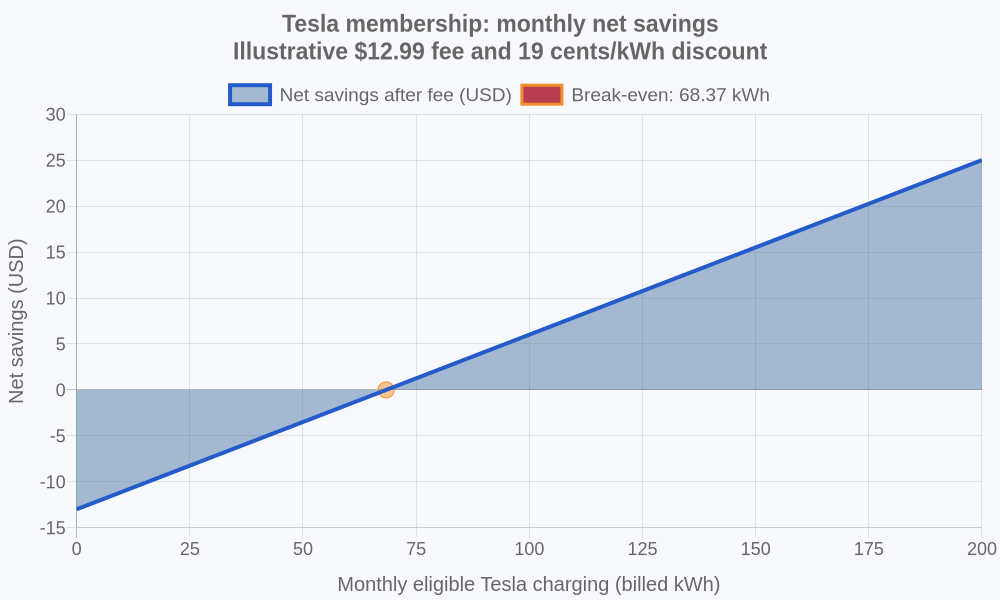
Open the net-savings graph at full size.
Original GearUp graphic, rendered by QuickChart. GearUp calculation: net savings = Q × $0.19 − $12.99. This graph uses assumptions, not a current Tesla tariff.
How a different discount moves the threshold
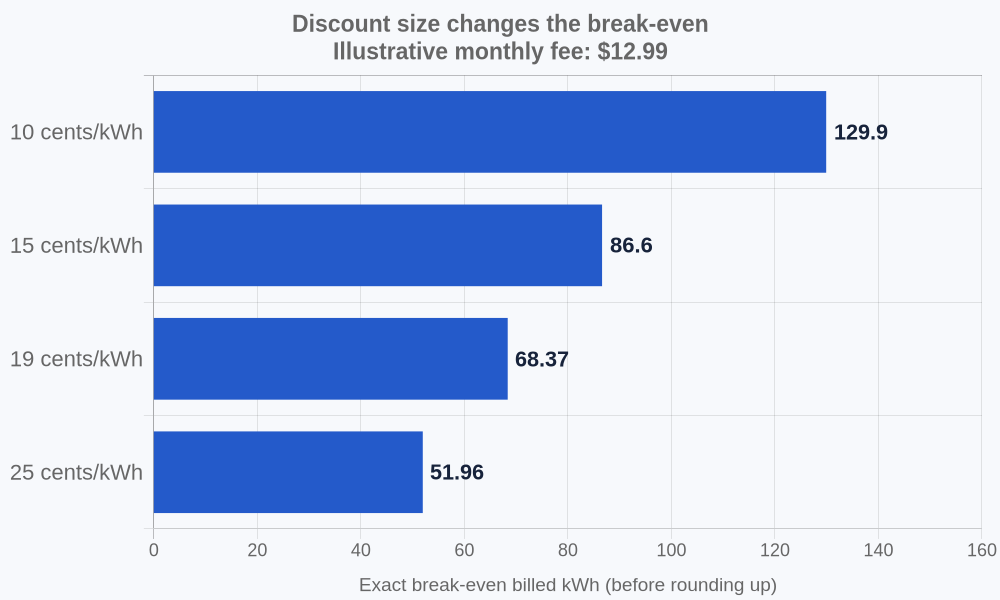
View the discount sensitivity graphic in full.
| Saving / kWh | Exact kWh | Whole kWh |
|---|
| 10¢ | 129.90 kWh | 130 kWh |
| 15¢ | 86.60 kWh | 87 kWh |
| 19¢ | 68.37 kWh | 69 kWh |
| 25¢ | 51.96 kWh | 52 kWh |
If your fee differs, multiply each exact threshold by your fee ÷ $12.99, or calculate F ÷ d directly. At a $15 fee and 19¢ discount, the threshold becomes 78.95 kWh. Recalculate the table and graphics before publication if the article switches to a verified fee. The 10¢ → 130 / 15¢ → 87 / 19¢ → about 68 / 25¢ → 52 shorthand is rounded; “about 68” is not a profitable 68-kWh month.
Translate the threshold into driving distance
At an assumed 3.0 miles per billed charging kWh, 68.37 kWh corresponds to about 205 miles supplied by eligible Tesla charging, not 205 total miles driven. At 2.5 and 3.5 miles per billed kWh, it represents about 171 and 239 miles. These efficiency values are planning assumptions, not vehicle ratings or measured averages.
If Tesla supplies only 20% of your driving energy and the same 3.0-mile assumption holds for that mix, roughly 1,026 total monthly miles would be needed to reach this Tesla energy threshold. Do not count home charging or another network's energy toward the Tesla subscription. Use the charging cost calculator to budget the wider home/public mix, and the public charging cost guide for total-session context.
For this mileage translation, efficiency must share the billed-energy basis of Q. If using battery-only efficiency, account for relevant charging losses once; do not add a blanket loss factor to an efficiency that already includes them.
A road-trip month can work when an ordinary month does not
Suppose four eligible stops deliver 45 kWh each in one billing period: 180 kWh. At the illustrative 50¢ non-member rate, energy costs $90. At 31¢ member pricing, energy costs $55.80, plus the assumed $12.99 fee, for $68.79 total. Net savings are $21.21. Common extra fees are excluded from both sides.
A quiet month with only 25 Tesla kWh loses $8.24 under the same assumptions. Two 180-kWh travel months and ten zero-use months illustrate the renewal risk: exactly two paid cycles would save $42.42; twelve paid cycles would lose $87.48 ($68.40 energy discounts minus $155.88 fees). Those are alternatives, not a promise that cancellation gives exactly the billing dates you want. Check the app before the trip and before renewal.
For a route with different discounts, two 45-kWh stops saving 10¢ and two saving 25¢ produce $31.50 before the fee, or $18.51 net. The energy-weighted discount is 17.5¢, not 19¢.
When to join—and when to skip it
Join when your conservative forecast of eligible Tesla savings exceeds the verified fee with room for a missed stop. A predictable road trip or repeated local Supercharging can qualify. Compare the resulting total with a convenient alternative charger before making a detour for a discount.
Skip it when your Tesla energy falls below break-even, home/work charging covers nearly everything, a free automaker benefit already covers your stops, or incompatible sites dominate your route. At 75 kWh and a 19¢ discount, $1.26 net savings is a thin margin: an extra parking charge or detour can erase it. Count only energy you would buy anyway.
Compatibility and adapters: verify before paying the fee
Use Tesla's vehicle-specific charging map or enter the exact model in the app. There are Tesla-only, Magic Dock and eligible NACS sites; a membership does not change vehicle eligibility. CCS1 vehicles need the appropriate DC adapter supplied by Tesla or the vehicle manufacturer. Tesla prohibits third-party adapters for Supercharging; an AC adapter is not a substitute.
Check manufacturer instructions, software readiness and cable reach for the actual vehicle. Native NACS can eliminate an adapter requirement, but does not make every station compatible. Charging speed also depends on vehicle and charger, so “one session” is a poor financial unit: use the receipt's billed kWh.
Time-of-use and live pricing change the discount you can earn
Some sites have scheduled peak/off-peak rates. Others have occupancy-based live pricing. Tesla's live-pricing explanation says prices can change before arrival but lock when the session starts; eligible non-members can still use these sites at the app's default rate.
Capture member and non-member prices for the same site and planned charging time, then check again before starting. Do not subtract an off-peak member rate from a peak non-member rate and call the whole gap a membership benefit. Congestion charges are separate: membership should not be treated as a waiver. Use the actual total fee in F and consistent inclusive/exclusive tax treatment for both rates.
How this differs from GearUp's general membership guide
The network-wide charging membership comparison compares subscription structures across networks, including session-fee effects. This Tesla-specific guide answers a narrower question: how much eligible Tesla-app energy must a non-Tesla driver buy to recover one month's fee? It adds Tesla account rules, adapter eligibility, live pricing and a trip-month calculation rather than ranking every charging plan again.
GearUp Take
Buy the discount for charging you already expect to do. The useful number is neither your battery size nor all your public charging: it is eligible Tesla kWh multiplied by the price difference at the stops you will use. Revisit the subscription after a travel month. A good road-trip purchase can be a poor year-round habit.
Help build GearUp's Real-World Data
Compare these scenarios with GearUp's approved charging-session records. To help test the model, submit a Tesla charging receipt or app screenshot with billed kWh, total cost, membership status, site and charging time. Follow the submission form's privacy guidance and omit payment credentials. These calculations are not based on that dataset; a small sample should not be called a national average.
Methodology and limitations
Facts: Tesla's public support and payment policies; Paren's dated aggregate pricing benchmarks. Assumptions: $12.99 fee, 19¢ discount, 50¢/31¢ illustrative tariff pair, session sizes and efficiency. Calculations: the tables, graph, mileage equivalents and trip outcomes derived from those stated inputs. Public sources checked October 14, 2026; no current Tesla-app fee or local price pair was verified.
Q is station-billed energy for eligible sessions in one subscription period. We subtract F once, use unrounded inputs and round dollar results only at display. Exact thresholds are shown to two decimals; practical whole-kWh thresholds round upward. For the 17.3¢ benchmark calculation, subtracting two rounded national averages adds uncertainty and does not reproduce a specific route. If actual subscription taxes or charges increase F, replace it with the full cost.
We exclude adapter purchase, parking, detours, waiting time, promotions and congestion fees from the base model. Fees identical in both alternatives cancel only if behavior is identical. Add any different charges explicitly. Per-minute billing needs a minutes-and-rate-tier comparison, not this kWh formula. The model does not guarantee charger availability, charging speed or the cheapest network. Any verified fee change requires regenerating all fee-dependent numbers and visuals together; no static chart updates itself from the Tesla app.
FAQ
Can a non-Tesla EV use a Supercharger without membership?
Yes, at compatible sites. The subscription lowers eligible charging rates; it is not the requirement for network access.
Is the monthly fee definitely $12.99 in 2026?
This review cannot confirm that from Tesla's public U.S. pages. The terms direct drivers to the app. Here $12.99 is a scenario input; verify the current app price before publication and before buying.
Does 68 kWh cover a $12.99 fee?
Not exactly at a 19¢ discount: 68 × $0.19 − $12.99 = −$0.07. Exact break-even is 68.37 kWh; 69 whole kWh produces a positive result.
What does the latest Tesla pricing benchmark imply?
Paren's Q3 2026 Tesla averages differ by 17.3¢/kWh. If your fee were $12.99 and that difference matched your stops, break-even would be 75.09 kWh. Your app quote can yield a different result.
Can I join only for a road trip?
You can consider it for a travel billing period. The plan renews monthly; verify its renewal date, cancellation timing and non-refundable fee before assuming one payment covers the whole trip.
Will membership make my adapter or charging speed work better?
No. Vehicle access, a supported DC adapter where required, software and charger capability must be checked separately.
Do home charging and other networks count?
No. Only eligible discounted Tesla sessions help recover this fee. Energy charged elsewhere belongs in your overall charging budget, not the Tesla break-even volume.